
Data centre Deployment
How Much Does Data Centre Deployment Cost in Nigeria? 7 Key Factors
If your organisation is planning a data centre deployment in Nigeria, one of the first questions you are likely to ask is: How much will it cost?
How Much Does Data Centre Deployment Cost in Nigeria? 7 Factors That Affect Your Budget
If your organisation is planning a data centre deployment in Nigeria, one of the first questions you are likely to ask is: How much will it cost?
You may be installing new servers, expanding an existing data centre, setting up a server room, upgrading network infrastructure or bringing equipment into an operational environment. Whatever the project, you need to understand the likely investment before committing your budget.
The challenge is that data centre deployment is not one standard service with one standard price. A project involving the physical installation of a few servers is different from a deployment requiring equipment supply, structured cabling, network configuration, testing, documentation and coordination across multiple teams.
The same is true when comparing quotations. Two providers may appear to be pricing the same project but include different equipment, labour, technical activities and responsibilities.
In this guide, we explain the seven major factors that influence data centre deployment costs in Nigeria, what to look for in a quotation, and how to prepare your requirements so you can make a more informed decision.
Is There a Standard Price for Data Centre Deployment in Nigeria?
There is no single price that accurately represents every data centre deployment project.
The cost depends on what you need installed, the condition of your existing environment, the amount of equipment involved, the technical work required and what the provider is responsible for delivering.
For example, a company that has already purchased its servers and prepared its racks may only need onsite installation and agreed verification. Another organisation may require equipment supply, racks, structured cabling, power distribution, network configuration, testing and project coordination.
These are different scopes of work, so their quotations should not be expected to match.
The most useful starting point is not an average price. It is a clearly defined project scope.
Before requesting a quotation, establish what needs to be supplied, what needs to be installed, which systems must be connected, what must be tested and what documentation you expect at handover.
Once these requirements are clear, providers can price the work against a more consistent set of expectations.
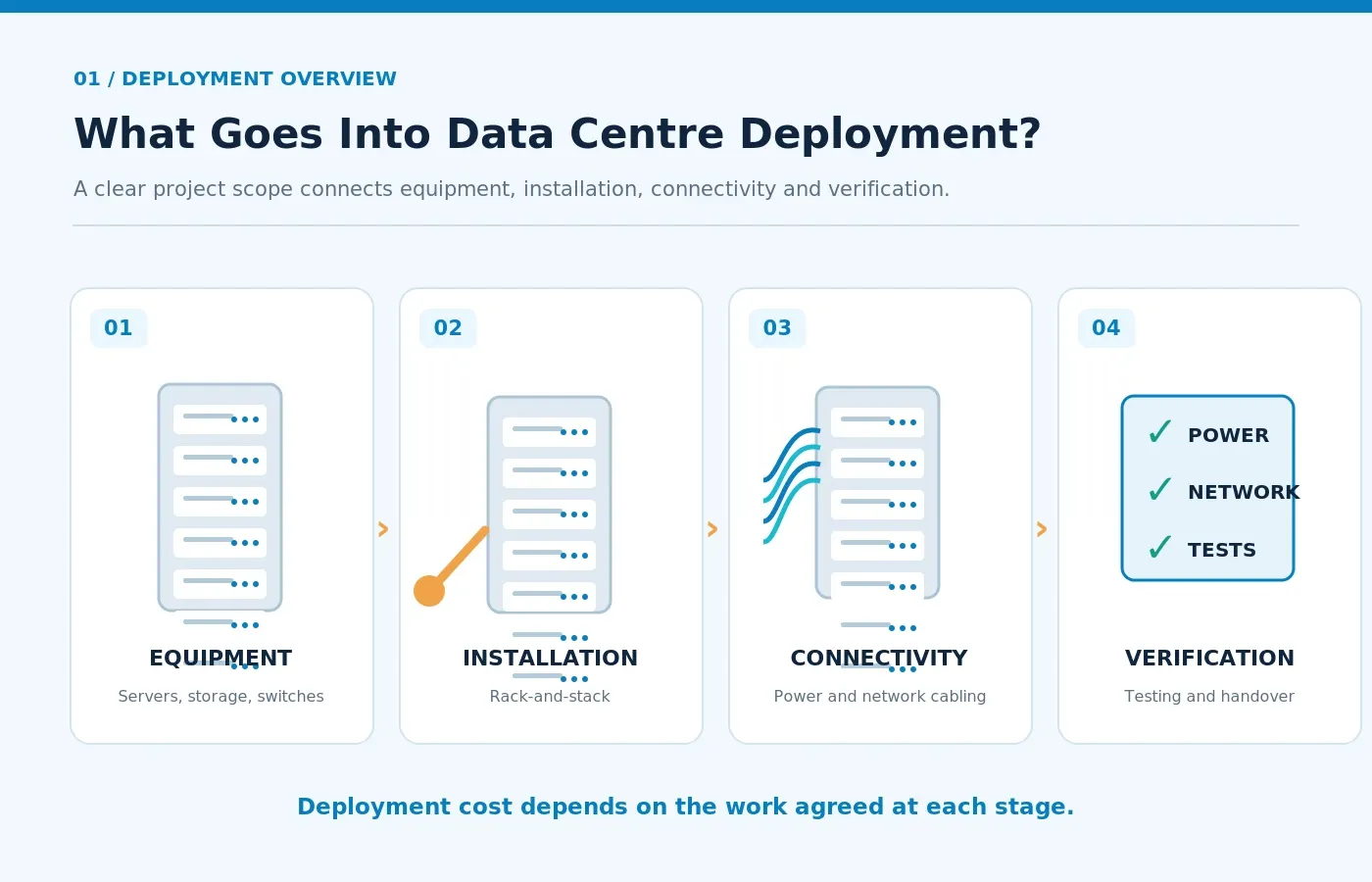
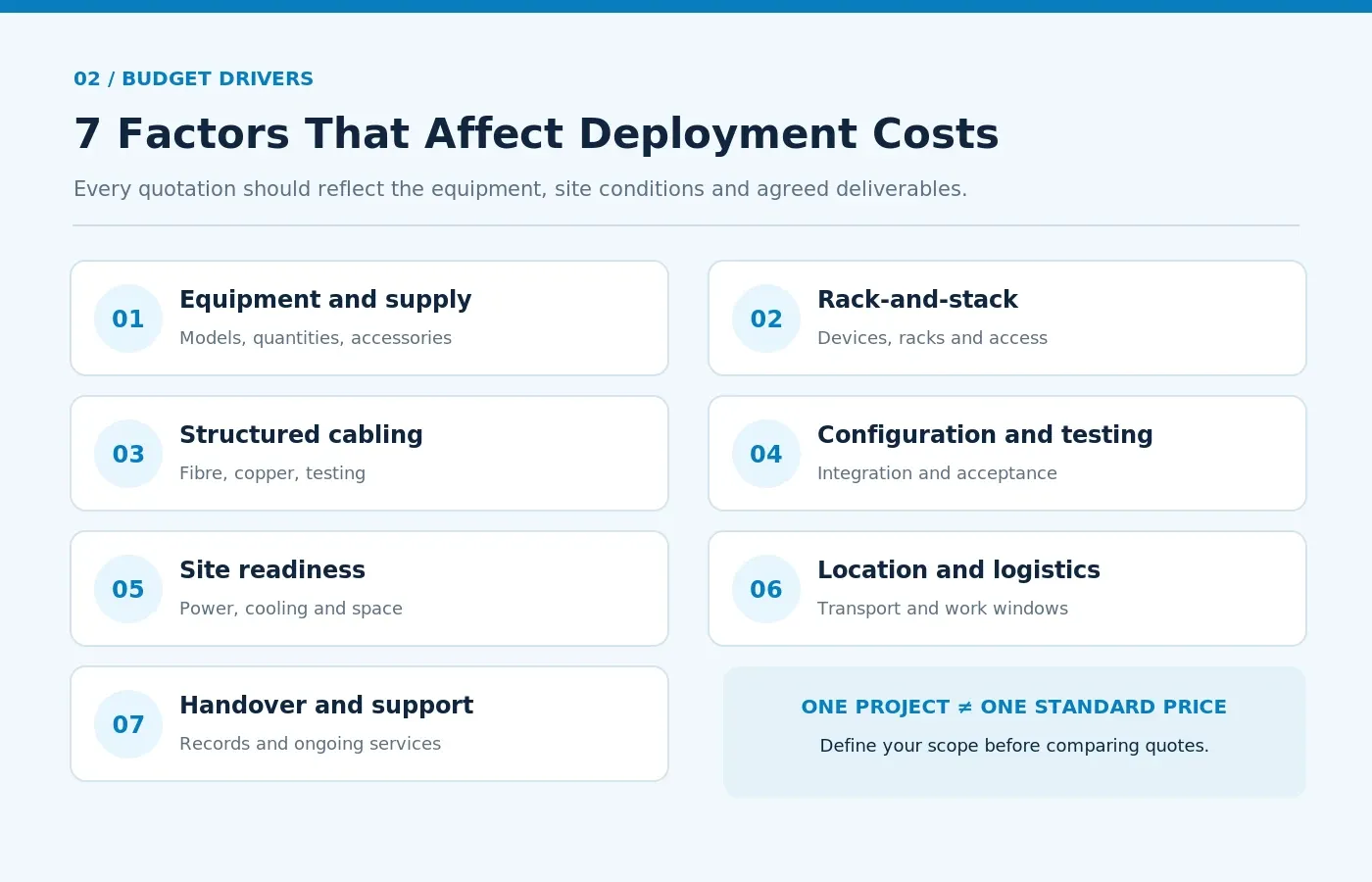
7 Factors That Affect Data Centre Deployment Costs
1. Equipment Type, Quantity and Supply Requirements
Equipment is one of the first things to clarify when estimating a deployment budget.
Your project may involve servers, storage systems, network switches, firewalls, rack enclosures, power distribution units, cabling components or environmental monitoring equipment.
The cost implications depend on the specific products, quantities, specifications and supply responsibilities involved.
Consider these questions:
- Have all the required equipment and accessories already been purchased?
- Does the project require the provider to source and supply hardware?
- Are the exact models, quantities and specifications confirmed?
- Are mounting rails, transceivers, power cables and other accessories included?
- Are licensing, warranties or subscriptions part of the requirement?
- Is any existing equipment being reused, relocated or replaced?
Equipment supply and installation should not automatically be treated as the same service. A quotation for hardware does not necessarily include the work needed to install, connect, configure and verify it.
If you have already purchased your equipment, provide an accurate equipment schedule. If the provider is responsible for supply, ask for the proposed specifications, quantities, pricing and relevant warranty information to be documented separately where appropriate.
This makes it easier to understand how much of your budget relates to the equipment itself and how much relates to deployment.
2. Rack-and-Stack and Physical Installation
Rack-and-stack refers to the physical installation of equipment into server racks or cabinets.
Depending on the agreed scope, this may include positioning equipment, installing mounting rails, securing devices, arranging equipment according to a rack layout, connecting power and network cables, and organising the installation for future maintenance.
The cost of this work can vary according to the number and type of devices, the installation environment, access conditions and the amount of work required.
For example, installing a few straightforward rack-mounted devices is not the same task as coordinating a larger installation involving several equipment types, restricted access and a detailed rack layout.
Before requesting a quotation, clarify:
- How many devices need to be installed?
- Are the racks and mounting accessories ready?
- Is an approved rack layout available?
- Does the work require equipment removal or relocation first?
- Are cable management and labelling included?
- Must the work take place within a specific maintenance window?
- What installation records are required?
These details help a provider estimate the actual work rather than price the project based on an incomplete description.
Ideal Solutions provides data centre deployment and rack-and-stack services for organisations that need onsite support to move equipment from delivery towards operational readiness.
3. Structured Cabling and Network Connectivity
A deployment may require new copper or fibre connections, patch panels, transceivers, cable management, labelling and testing.
The scope depends on the network design, the number of connections, the cable types required, the routes available and whether existing infrastructure can be reused.
A project that only needs equipment connected to existing, suitable infrastructure may require different work from one that needs new cable routes, additional patch panels, new network racks or extensive connectivity changes.
Ask your provider:
- How many connections are required?
- Which cable types and specifications apply?
- Are cable routes and termination points already available?
- Does the work include cable installation, termination and labelling?
- Will the completed cabling be tested?
- Are test results and connection records included?
- Who is responsible for network configuration and end-to-end connectivity verification?
One important distinction is that physical cabling and complete network configuration are not necessarily the same responsibility.
A quotation should explain whether the provider is installing and testing the physical connections only or also configuring the relevant network equipment and verifying the agreed connectivity requirements.
Leaving this unclear can result in additional work being discovered after installation has started.
4. Configuration, Integration and Testing
Physical installation does not automatically mean that infrastructure is ready for its intended use.
Depending on the project, equipment may need initial configuration, network integration, storage preparation, connectivity checks, firmware or management setup, and other activities defined by the approved technical requirements.
Testing and verification also need to be considered. The appropriate checks depend on the equipment and the acceptance criteria agreed for the project.
For example, a project might require confirmation that equipment is installed correctly, power and network connections are complete, devices report an expected status, and specified configuration or connectivity checks have passed.
Ask your provider to identify:
- Which devices will be configured?
- Which integration activities are included?
- What testing will be performed?
- Who defines and approves the acceptance criteria?
- Will test results be documented?
- How will defects and outstanding issues be handled?
- Which activities remain the responsibility of your internal IT team or another contractor?
These details matter when comparing quotations. One proposal may cover physical installation only, while another includes configuration, testing and documented handover.
The difference in price needs to be understood alongside the difference in deliverables.
Ideal Solutions' deployment approach emphasises that installation should be checked and verified against the agreed requirements before sign-off. Explore the data centre deployment service to understand the areas that may form part of your project scope.
5. Site Readiness and Existing Infrastructure Conditions
Your existing environment can significantly influence the amount of work required.
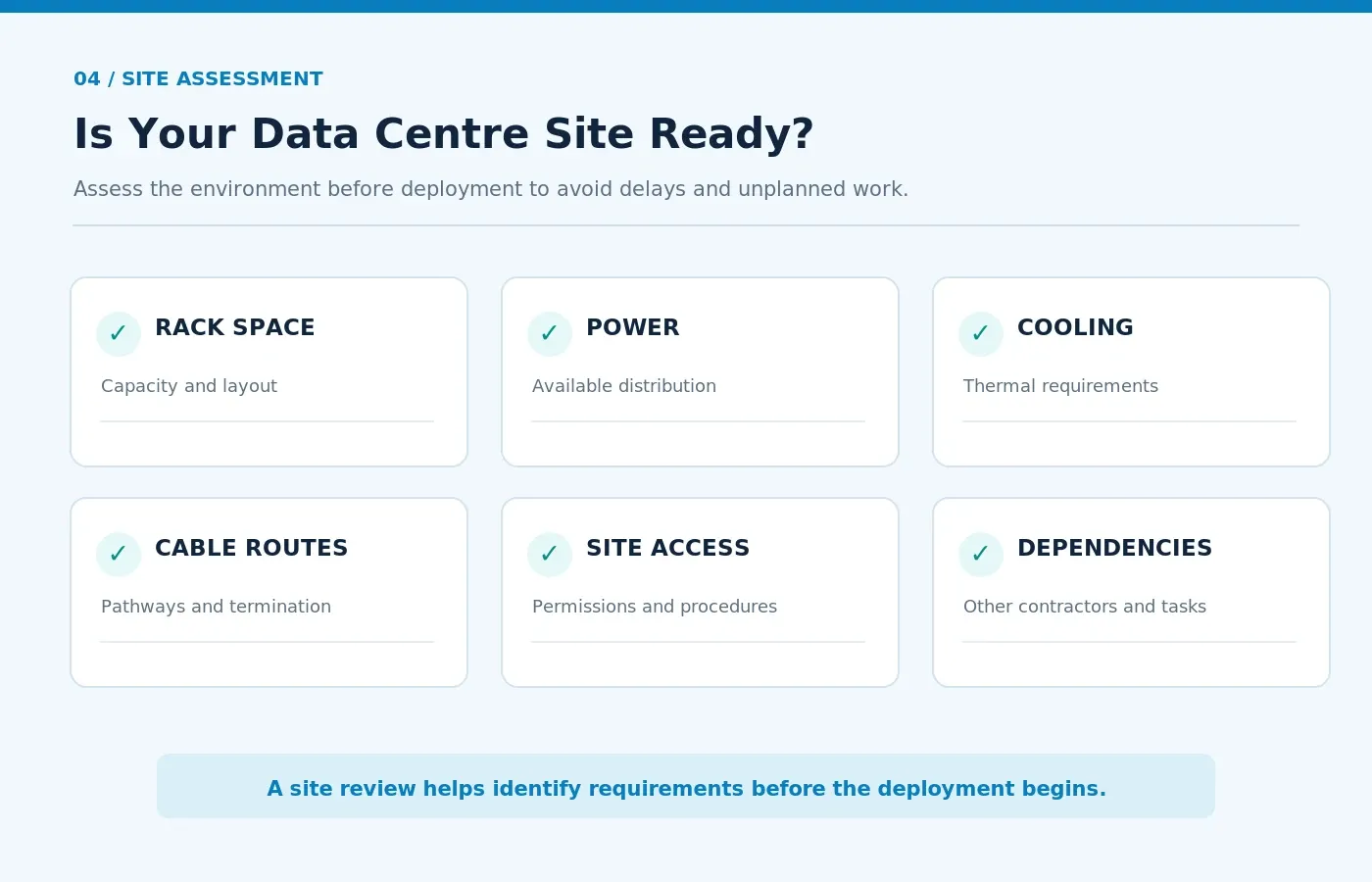
Before equipment is installed, relevant conditions may need to be reviewed, including available rack space, power capacity, cooling considerations, physical access, cable routes and the condition of existing infrastructure.
A project may appear straightforward on paper but require additional work if the environment is not ready for the planned installation.
For example, adding equipment to an existing room may require additional assessment of power distribution, rack capacity, cabling or cooling dependencies. A relocation may require identification and labelling before equipment can be safely removed and transported.
These requirements should be identified early, with responsibility assigned to the appropriate parties.
Ask:
- Is the installation area ready?
- Is sufficient rack space available?
- Have relevant power and cooling requirements been assessed?
- Are the required cable routes and connections available?
- Are access permissions and site procedures understood?
- Will other contractors need to complete work first?
- Who is responsible for identifying and resolving site-readiness issues?
Not every deployment provider is responsible for electrical, mechanical or cooling works. If specialist contractors are needed, their responsibilities and costs should be made clear rather than assumed to be included in the deployment quotation.
A site assessment or review of the available technical information can help identify these dependencies before they create delays or unplanned expenses.
6. Project Location, Logistics and Execution Schedule
The location and conditions under which the work must be completed can also affect the budget.
A project may involve transporting equipment, coordinating deliveries, moving hardware between facilities, arranging site access or working within an agreed maintenance window.
For some organisations, deployment activities must fit around existing operations. The available work window, access restrictions and dependencies on other teams may influence the resources and coordination required.
If equipment must be moved, the scope may also include identification, labelling, deinstallation, packaging, loading, transportation, offloading and preparation at the destination.
These are separate activities that should be identified in the quotation where applicable.
When discussing the schedule, clarify:
- Where will the work take place?
- Are there multiple sites or deployment locations?
- Who is responsible for equipment delivery and transportation?
- Are loading, offloading and packaging required?
- What access arrangements must be completed before work begins?
- Is the work restricted to a particular date or maintenance window?
- Which activities depend on other teams or suppliers?
The objective is to identify the actual logistical and scheduling requirements, not to assume that every project will incur the same charges.
For relevant projects, Ideal Solutions has documented its work on data centre equipment decommissioning and relocation from Medallion to OADC. The documented scope included equipment and cable identification, deinstallation, packaging, loading, transportation, offloading and logistics support.
That example illustrates why a relocation project must be scoped differently from a straightforward installation. It does not establish a standard price for relocation work.
7. Documentation, Handover and Ongoing Support
The work does not necessarily end when the equipment has been installed.
Depending on the agreed requirements, a deployment may need rack layouts, equipment inventories, cable schedules, test results, configuration records, outstanding-issue lists and other handover documentation.
The project may also require additional support after installation, such as planned maintenance, onsite technical assistance, troubleshooting or future infrastructure changes.
These activities should be discussed before the contract is signed because they may be included in the deployment scope, priced separately or covered under a different support arrangement.
Ask your provider:
- What documents will be delivered at handover?
- Are equipment inventories and cable labels included?
- Will test results and outstanding issues be recorded?
- Is post-installation support included?
- How long does the agreed support period last?
- What support arrangements are available afterwards?
- Which activities will incur additional charges?
Clear handover requirements help your team understand what was installed, what was verified and what remains to be completed.
They also make future maintenance and troubleshooting easier to plan.
Do not assume that ongoing support is included simply because the provider has completed the installation. Confirm the arrangement in writing.
What Ideal Solutions' Case Studies Tell Us About Project Scope
Real projects help demonstrate why a single deployment price is not meaningful without understanding the work involved.
Ideal Solutions' published case studies describe several different types of infrastructure requirements.
Environmental monitoring hardware for Open Access Data Centres (OADC)
The documented project involved supplying environmental monitoring and network hardware for deployment across five data halls, including 307 wireless temperature and humidity sensors, wireless cooling duty meters, receivers, rack equipment and PoE switches.
Read the OADC environmental monitoring hardware case study.
Equipment decommissioning and relocation from Medallion to OADC
This project covered identifying and labelling equipment and cables, deinstallation, packaging, loading, transportation, offloading and logistics support.
Read the OADC equipment relocation case study.
Network and wireless infrastructure at South West Bitumen's Ore facility
The documented work included network equipment supply and installation, Cat6 structured cabling, rack installation, PDU and UPS installation, wireless equipment, rack mounting and network configuration.
Read the South West Bitumen network infrastructure case study.
These examples involve different equipment, activities and execution requirements. They demonstrate why a useful quotation must reflect the actual scope of work.
The published case studies do not provide project contract prices, so they should not be used as price benchmarks. Their value is in showing the types of work that need to be defined before a realistic budget can be prepared.
How to Compare Data Centre Deployment Quotations Fairly
Once you receive proposals, resist the temptation to compare only the final figures.
Start by checking whether each provider has priced the same requirements.
Use the following checklist:
| Area to compare | What to confirm |
|---|---|
| Equipment | Are the specifications, quantities and supply responsibilities clear? |
| Installation | Which devices and physical installation activities are included? |
| Cabling | Are materials, installation, labelling and testing covered? |
| Configuration | Which configuration and integration activities are included? |
| Site readiness | Are site conditions and dependencies identified? |
| Logistics | Are delivery, relocation and transportation responsibilities clear? |
| Testing | What will be tested, and what constitutes acceptance? |
| Project coordination | Who manages dependencies, schedules and other contractors? |
| Documentation | Which records and handover documents will be provided? |
| Support | What assistance is included after deployment? |
| Exclusions | Which activities, materials or services are not included? |
| Commercial terms | How are payment milestones, variations and additional work handled? |
If one quotation is lower than another, ask the providers to explain the differences in scope.
A lower price may be appropriate if your organisation needs fewer services or already has the people and resources to handle certain activities internally. It may also reflect a narrower proposal that excludes work you still need.
The objective is not to select the most expensive proposal or the one with the most items. It is to understand what your organisation will receive and whether the proposed scope meets your requirements.
For a more detailed guide to evaluating providers, read How to Choose a Data Centre Deployment Provider in Nigeria: What to Check Before You Sign a Contract.
How to Prepare for a More Accurate Deployment Quote
You can make the quotation process more productive by preparing a short project brief before approaching providers.
You do not need to have every technical detail finalised, but the more information you can supply, the easier it becomes to identify the scope, assumptions and outstanding questions.
Include the following where available:
- Project objective: Explain whether you are deploying new equipment, expanding capacity, refreshing infrastructure, relocating equipment or modifying an existing environment.
- Equipment schedule: List the devices, quantities, models and accessories involved, including which items have already been purchased.
- Site information: Identify the location, existing environment, available rack space and relevant access arrangements.
- Technical requirements: Provide the available rack layout, network design, cabling requirements and approved specifications.
- Required activities: Identify whether you need equipment supply, installation, cabling, configuration, testing, documentation, relocation or project coordination.
- Schedule: State the target date, preferred work window and any dependencies that could affect delivery.
- Acceptance requirements: Explain how your organisation will determine that the work has been completed satisfactorily.
- Support expectations: Clarify whether you need installation and handover only or additional ongoing technical support.
If some details are not yet available, identify them as open questions. A good project discussion should help establish what needs to be confirmed before the scope and price are finalised.
Frequently Asked Questions
How much does data centre deployment cost in Nigeria?
The cost depends on the equipment, quantity of devices, installation requirements, cabling, configuration, testing, site readiness, logistics and support arrangements. There is no single price that applies to every project. A meaningful quotation requires a defined scope and an understanding of the relevant site conditions.
Does a data centre deployment quotation include equipment?
Not necessarily. Some proposals include equipment supply and installation, while others cover labour and technical execution using equipment supplied by the customer. Confirm the equipment schedule, supply responsibilities, warranties and exclusions before approving the quotation.
Is rack-and-stack cheaper than a complete data centre deployment?
Rack-and-stack covers physical equipment installation, while a broader deployment may include cabling, configuration, integration, testing, documentation and coordination. The cost comparison depends on which activities your project actually requires and which responsibilities your internal team can handle.
What can make a data centre deployment more expensive than expected?
Unclear requirements, missing equipment or accessories, unprepared sites, additional cabling, unexpected infrastructure constraints, schedule changes and work outside the agreed scope can affect the final cost. Early planning and clearly documented assumptions help reduce uncertainty.
Should testing and documentation be included in the quotation?
They should be explicitly addressed. The appropriate tests and handover documents depend on the project. Confirm which checks will be performed, what evidence will be delivered and how outstanding issues will be handled before work begins.
Can Ideal Solutions support a project if we have already purchased the equipment?
Ideal Solutions provides onsite deployment support, including rack-and-stack, equipment installation, connectivity, testing and verification according to the agreed project requirements. Share your equipment schedule and the activities you need so the appropriate scope can be discussed.
What information should I send to request a deployment quote?
Start with your project objective, site location, equipment list, available technical documentation, required activities, target schedule and expected handover. If you do not have every detail, explain what is known and what still needs to be assessed.
Plan Your Data Centre Deployment with Ideal Solutions
The right deployment budget starts with a clear understanding of the work.
Before comparing prices, establish what must be supplied, installed, connected, configured, tested and documented. Identify the condition of the existing environment, clarify responsibilities and make sure exclusions and support arrangements are understood.
That gives your organisation a stronger basis for evaluating proposals, preparing its budget and deciding how the work should be delivered.
Ideal Solutions supports organisations that need onsite technical execution for data centre and IT infrastructure projects in Nigeria, including equipment installation, rack-and-stack, network infrastructure, deployment verification and related lifecycle services.
If you are planning a new deployment, expanding an existing environment or preparing equipment for relocation, share your requirements so the scope and next steps can be discussed.